ZIMBABWE SEXUAL AND REPRODUCTIVE HEALTH INFOGRAPHIC SNAPSHOT ..download document.
Good sexual and reproductive health is a state of complete physical, mental and social well-being in all matters relating to the reproductive system. It implies that people are able to have a satisfying and safe sex life, the capability to reproduce and the freedom to decide if, when, and how often to do so.
To maintain one’s sexual and reproductive health, people need access to accurate information and the safe, effective, affordable and acceptable contraception method of their choice. They must be informed and empowered to protect themselves from sexually transmitted infections.
And when they decide to have children, women must have access to skilled health care providers and services that can help them have a fit pregnancy, safe birth and healthy baby. Every individual has the right to make their own choices about their sexual and reproductive health.
Long Life community trust together with a wide range of partners, works toward the goal of universal access to sexual and reproductive health and rights, including family planning.
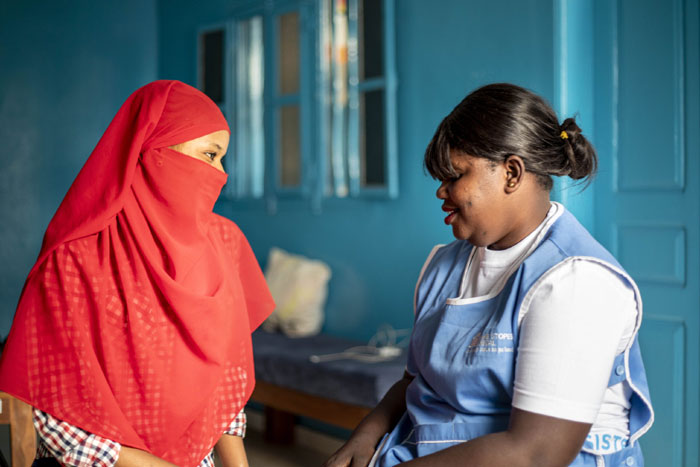
Implementation of the Project/Activity
Our training and our outreach is centered around on the question WHY family planning. Only when people are aware that this can help them escape poverty does the question of HOW (use of contraceptives) arise. In doing so, we cooperate with national institutions, government authorities and health centers and motivate women AND men that they use modern contraceptives and to take advantage of local services. Our funding comes from private donors, national calls on development cooperation, and foundations. All projects pass through monitoring and evaluation, and beginning with 2025 we have installed studies of measurement in some projects. Our approach is highly accepted and successful since we follow a unique strategy: 1. We operate with local trainers and multipliers since they adapt the knowledge for their beneficiaries into the respective socio-cultural context. 2. Our training curriculum is subject to constant qualitative improvement and is continuously expanded by didactic and modern methods. Our RAIN WORKERS are involved in the process and they give us constantly their feedback. 3. We have developed educational tools (Big 5 RAIN TOOLS), which simply and understandably explain complex facts and break taboos: The WHY FAMILYPLANNING-TOOL explains the five basic needs of each person (Love, Health, Food & Water, Education, Peace) and how people can “take their future into their own hands”. The CYCLE TOOL “BABY NECKLACE” explains the female cycle with fertile and unfertile days, and can also be used as a natural contraceptive. The uterine model “LITTLE MOM” shows the internal sexual organs of the woman. Contraceptive methods are therefore easy to explain. The MOTHER´S HEALTH TOOL is a calendar to understand the necessity of birth spacing and emphasizes the importance of contraception during breastfeeding. Our CLITORIS TOOL shows that the clitoris is an organ, which cannot be cut!
Enabling factors and constraints
Our success lies, first of all, in the fact, that we have local multipliers who own the respective socio-cultural knowledge, know about local taboos, and therefore are able to generate convincing arguments since they are from the same ethnic group/region/country. Secondly, we work with our specific RAIN TOOLS, which take away fear and break taboos. Thirdly, we teach people WHY family planning is important and can pull them out of the vicious cycle of poverty. Then we teach HOW and which contraception is available in the region. Finally, we are interconnected with local and national authorities. Our RAIN WORKERS get financial support in form of monthly allowance, but many of them work voluntarily since they have realized the importance of their work.
Sustainability and replicability
Applied family planning is like no other an investment is reaching the first aim of the SDGs, no poverty, and should be a cross section of all development cooperation projects. According to the United Nations Population Fund (UNFPA), gender equality and family planning are crucial in the fight against poverty. Targeted investments in education, reproductive health and women's economic rights promote sustainable development. Access to education and family planning therefore plays a crucial role. We encourage NGO´s and institutions especially in Africa, but worldwide, to adopt our curriculum to teach and train qualified local people. Only they have the key to the respective socio-cultural background of their beneficiaries and therefore can better convince them to break out traditional conceptions which are harmful